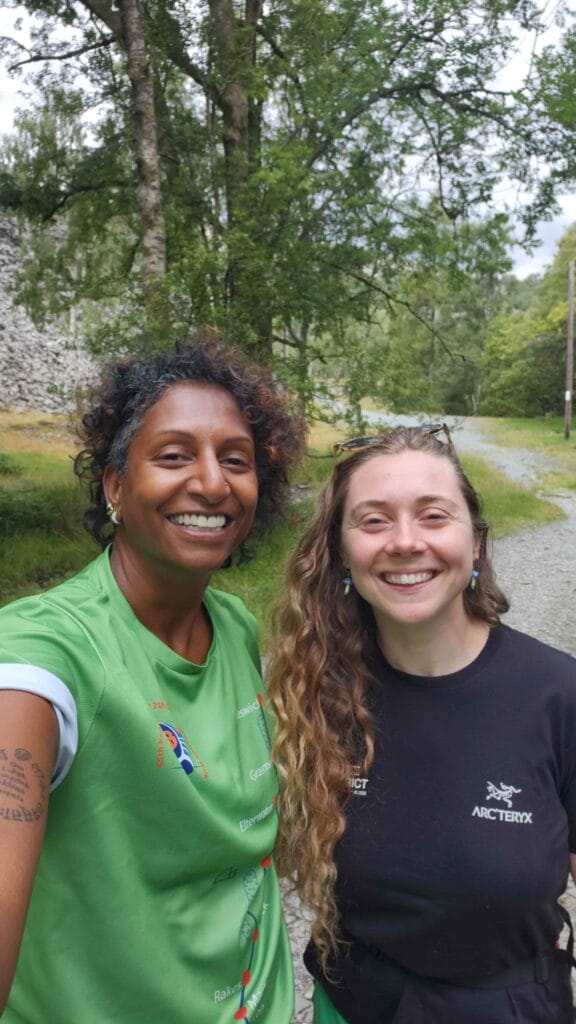
On a sun-kissed August morning in Little Langdale, I had the privilege of walking and talking with Lauren, whose connection to the Lake District runs as deep as the valleys themselves. As we took in the gorgeous surroundings of Little Langdale, we talked about how nature shapes our mental landscape, how we push our limits, and ultimately, how we find ourselves in the wild places.
The Quiet That Speaks Volumes
Living in the heart of the Lake District for nearly three years, Lauren has discovered something many of us spend a lifetime searching for: the healing power of silence.
“I’ve noticed that the quiet definitely helps my brain,”
she shared as we wound our way through narrow country lanes.
“I go to bed, it’s quiet. I wake up in the silence and my brain’s way less busy.”
In our hyperconnected world, where notification pings and endless scrolling have become the soundtrack to our days, this simple observation feels revolutionary. The absence of external noise creates space for our minds to settle, to process, to simply be.
Noticing Nature: Is This The Antidote to Modern Life?
Perhaps the most powerful insight from our conversation came when I asked Lauren about her advice for mental wellness through nature. Her answer wasn’t about epic mountain summits or ultramarathons (though she’s certainly conquered those). Instead, it was beautifully simple: notice more.
“What’s helped more recently is noticing more, what’s around me when I’m in nature,”
Lauren explained.
“Even if that’s just when I’m walking through town to go to work. like a cool bit of fungi, a cool plant, a tree.”
She spoke with genuine excitement about finding wood sorrel, describing its delicate clover-like shape with an infectious enthusiasm. If this is the essence of mindfulness, and not as some abstract concept, then I want more of it, to practice opening my eyes to the extraordinary in the ordinary.
For Lauren, this practice serves a crucial purpose:
“I can be quite locked into my own brain, so I try to look outwardly and be amazed at what’s around me.”
In doing so, she’s discovered that:
“you don’t have to feel like you have to go on a crazy long walk or run to feel something, to feel good.”
The Phone-Free Life: Reclaiming Our Attention
Our conversation naturally drifted to one of the modern world’s greatest challenges: our relationship with technology. Both of us shared strategies for creating boundaries with our devices, each approach slightly different but united by the same goal, protecting our mental space.
Lauren keeps her phone out of the bedroom entirely.
“I have a rule of phones literally not in the bedroom at night, so I sleep. I put it downstairs.”
For her, the morning hours are sacred, a time when she can wake without immediately diving into the digital world.
My approach involves keeping the phone nearby for emergencies but neutralising its addictive pull.
“I put it on Do Not Disturb, and it goes black and white,” I shared. “Who wants to watch TikTok on black and white?”
Lauren was very honesty about the ongoing struggle. “I know when it’s crept back in,” she admitted. This is about awareness and making intentional choices about where we direct our attention.
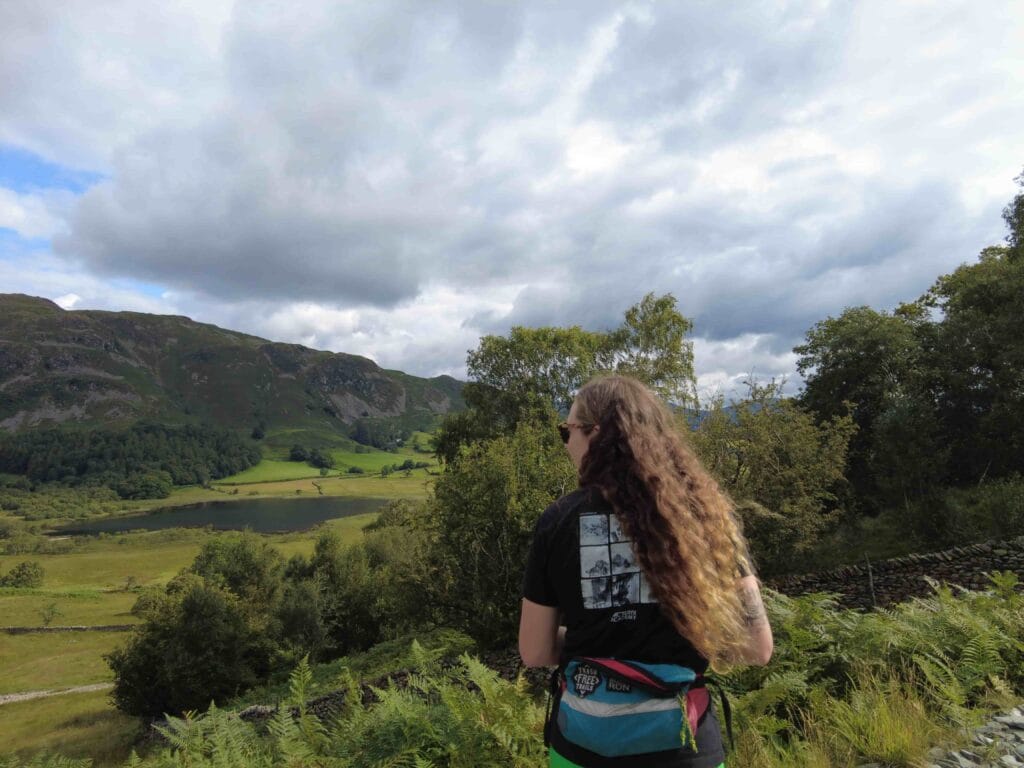
Pushing Boundaries: The Frog Graham Challenge
While our conversation centered on the small, mindful moments in nature, Lauren’s recent achievement deserves its own spotlight. This summer, she completed the Frog Graham Challenge to great success! It is a grueling test of endurance that involves running and swimming through the Lake District.
The logistics alone are staggering. Due to biosecurity concerns around invasive species in Derwentwater and Bassenthwaite, participants must switch to completely clean, dry kit before swimming in each of the lakes, with Buttermere being the only “clean” lake. This means coordinating multiple support crews, managing gear transitions, and maintaining mental focus through each stage of the challenge.
Lauren finished in in incredible 12 hours and 8 minutes, making her the CURRENT WOMEN’S RECORD HOLDER the Frog Graham Round! What is the Frog Graham round? It is an ultra challenge, running over 40 miles and ascending and descending 15,750 feet over the North Western Lake District fells, as if that wasn’t enough, Lauren also swam across Bassenthwaite Lake, Crummock Water, Buttermere and Derwentwater! #SlowClap!
What an immense achievement and the mental and emotional journey this represents is not lost on us!
Fun fact, Lauren is also the current women’s record holder for the Frog Whitton round; 100mile bicycle ride and 6 mile swim, broken up into 4 swims! Ooft!
I’m feeling the strain from the act of typing all that, haha!
Sport, Identity, and Self-Worth
Lauren’s relationship with sport hasn’t always been straightforward. She spoke candidly about her younger years when competitive sport became intertwined with her identity and self-worth.
“I realised that sport was achieving and sport was my identity, and that wasn’t good,” she reflected. “If I didn’t perform well, it had a big impact. It meant that I didn’t feel like a good enough person.”
The Frog Whitton Challenge brought these old patterns back to the surface. But this time, she approached it differently, supported by loved ones and armed with a healthier perspective:
“If I don’t get the record, it’s fine. I’m still a human who is loved and valuable.”
This evolution in her thinking represents something many athletes struggle with: separating achievement from worth, performance from identity. Lauren’s honesty about this ongoing work makes her journey all the more relatable and inspiring.
The Mountains as Teachers
Throughout our walk, the fells of the Lake District stood as silent witnesses to our conversation. For Lauren, they’re essential.
“The mountains are just so important and just amazing, and just like the views are fab,” she said with characteristic understatement.
These mountains teach us perspective. They’ve stood for millennia and will stand for millennia more. Our worries, our achievements, our struggles, they all unfold in the shadow of these ancient peaks, reminding us that we’re part of something far larger than ourselves.
Yet Lauren and her partner occasionally discuss the possibility of moving, perhaps to Scotland, to one of the islands. It’s a tension many of us understand: the pull between putting down roots and embracing change, between the comfort of the known and the curiosity about what else might be out there. For now, though, she remains anchored in Little Langdale, and quiet mornings.
The Practice of Presence
As we walked that morning, the August sun warming our backs, it was wonderful to share time and space with this wonderful human, and observe how she embodies the principles she shared. She pointed out fungi on walls, noticed birds, and engaged fully with her surroundings. She wasn’t performing mindfulness, this was a totally natural response to our environment and I was quite charmed by it!
I came away recognising and reinforcing to myself that wellness isn’t something we achieve or a destination we reach. It’s a practice, a daily choice to notice, to disconnect from our devices, to step outside, and to be amazed by the world around us.
Final Thoughts
Walking with Lauren through Little Langdale gently shows us that transformation doesn’t always require grand gestures. Yes, sometimes it looks like conquering an ultra challenge in twelve hours. But more often, it looks like noticing wood sorrel on your walk to work. It sounds like silence in the morning. It feels like leaving your phone in another room and actually watching the program you put on TV.
I’ve learnt that nature offers us a mirror and a teacher. It shows us how small we are in the face of mountains, yet celebrates the intricate beauty of a single fungus on a wall. It invites us to push our limits and to be still. To achieve and to simply be.
The Lake District will continue to draw visitors seeking its dramatic landscapes and challenging peaks. But perhaps alongside conquering the odd fell or two, we learn to notice the tiny, perfect things along the way. The quiet that allows our busy brains to settle. To practice looking outward instead of staying locked in our own narratives.
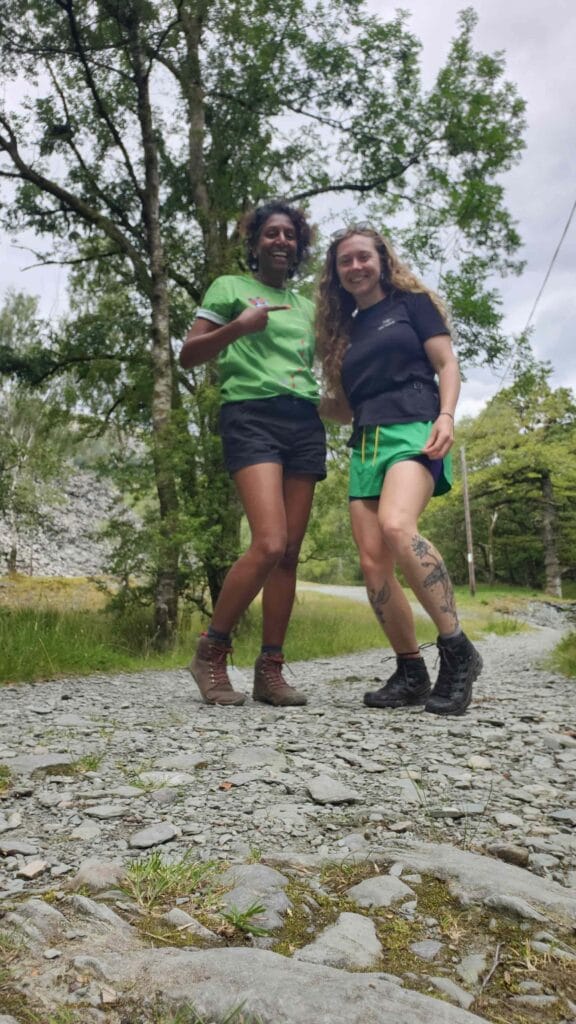
As Lauren and I parted ways that morning, both of us glowing (in reverse colours, as we amusingly noticed, her in green and black, me in black and green), I felt grateful. Grateful for the reminder that wellness is accessible, that nature is generous, and that some of the most transformative moments come to use in these moments we share on our walks. Movement is a wonderful tonic!
Here’s my invitation to you: Step outside today. Leave your phone behind, or at least put it on silent and grayscale. Notice something small and beautiful. Let the quiet settle your busy mind. You don’t need to run 40+ miles or swim across four lakes (though if you do, more power to you). You just need to be present, to notice, to be amazed by what’s already around you.
The mountains will be there, ancient and patient. The wood sorrel will bloom in its shaded spots. And somewhere in the space between striving and stillness, you might just find what you’ve been searching for all along.
Resources & Connect
Lauren Munro-Bennett is a Mountain Leader, ultra-runner, and ecologist based in Little Langdale, Lake District. She offers bespoke guided walks and runs, guided and coached swims, and 1-to-1 online coaching—all with a focus on connection with nature and mental health. Lauren believes the real magic is in noticing small things: “You don’t have to go on a crazy long walk to feel good.”
Links:
- Website: www.lmbcoaching.co.uk
- Instagram: https://www.instagram.com/laurenm_b
- Facebook: https://www.facebook.com/LMBtri
- LinkedIn: https://www.linkedin.com/in/lauren-munro-bennett-069907148/
S3’s music partner is: A Band Called Persimmon. You can check them out here:
https://www.youtube.com/@bandcalledPersimmon
Slater’s Bridge: A centuries-old stone packhorse bridge in Little Langdale, surrounded by oak woodland and the gentle flow of the River Brathay.
Little Langdale: The Lake District’s quieter valley—narrow lanes, traditional farms, dramatic fells, and the kind of silence that heals.