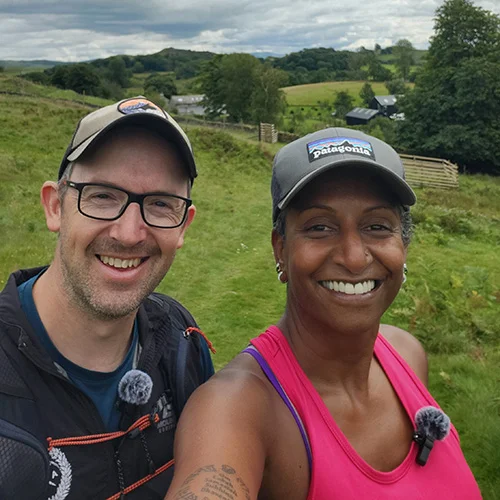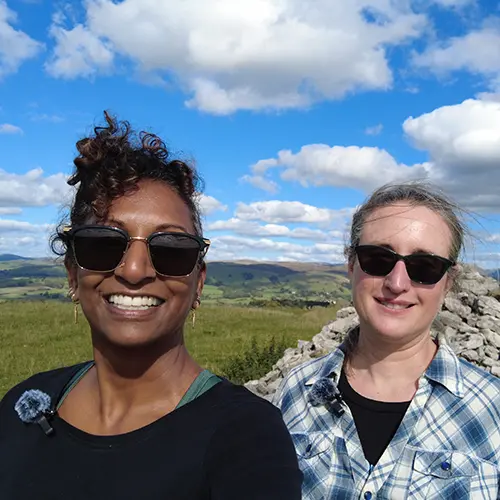

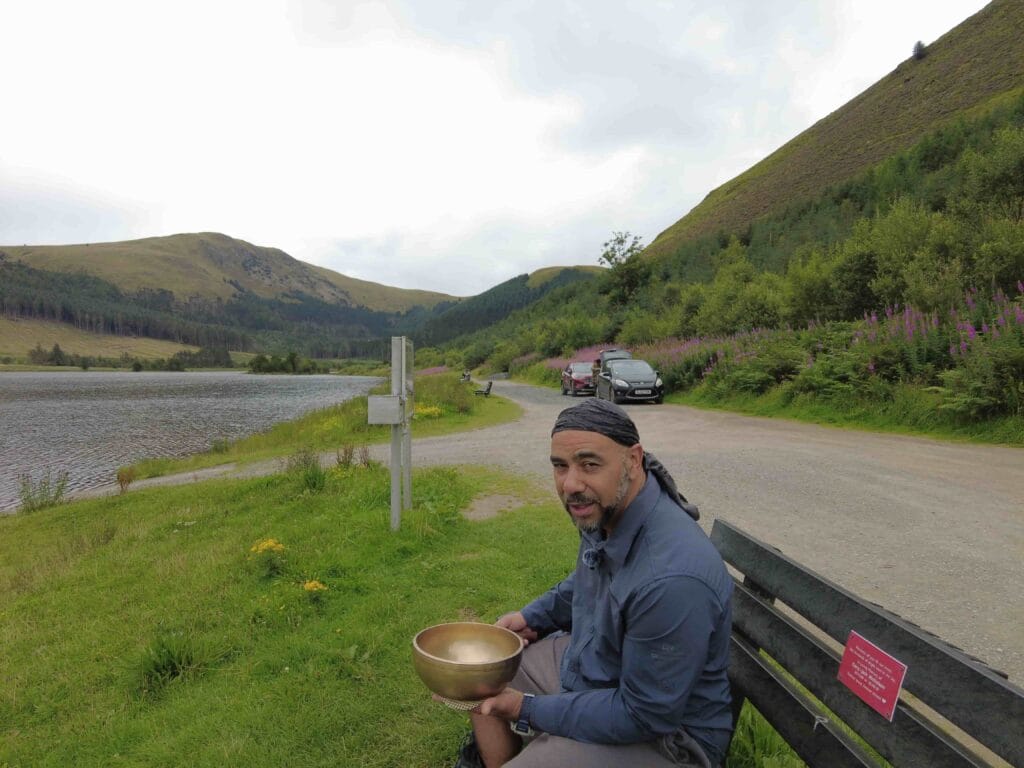
Walking through the stunning landscape of Cogra Moss in Cumbria, I had the privilege of sitting down with Rowan Carr, Cumbrian based yoga practitioner, meditation teacher, and founder, creator of Black Body Heart Mind. Our conversation wove through personal transformation, the tantric yoga philosophy, and the profound work of somatic healing for racial trauma.
From Birmingham to the Lakes: A Journey of Healing
Rowan’s path to Cumbria began with a honeymoon in 2002. He and his wife Lisa fell in love with the area and spent every holiday exploring the Lakes while working in Birmingham. In 2012, they took a leap of faith and handed in their notices at Bournville College and the University of Birmingham to work as campsite assistants in Eskdale.
“We did six months basically cleaning toilets and cutting grass,” Rowan laughs. “We worked four days and had three days off. We kinda did that to get our foot in the door.”
Looking back, Rowan realises it was his nervous system telling him he needed to run, to escape the toll that ten years of frontline racial justice work in Birmingham had taken on his body.
The Academic Foundation
Rowan’s journey into racial justice work began with a profound moment of awakening. Working as a forklift truck driver with a young daughter, when the brutal murder of Stephen Lawrence in 1993 changed everything.
“I thought to myself, brown forklift truck driver, I don’t think anybody’s really gonna listen to me in terms of what I’ve got to say. So what’s that mean? I’ve got to go and get the man’s paper.”
In his late 20s, he secured a place at the University of Birmingham to study Interdisciplinary African Studies which covered politics, history, culture, development, economics, spirituality, and religion. He emerged with a 2:1, becoming the first in his immediate family to earn a university degree.
“If you haven’t studied Africa, you haven’t studied the world,” Rowan emphasises. “The past 500 years wouldn’t be the way it is without Africa.”
He went on to complete a master’s degree in Race and Ethnic Studies at Warwick University, funded by a generous stranger, Marion McNaughton from Joseph Rowntree’s Racial Justice Committee. Marion wanted to use her mother’s inheritance for someone’s education. Rowan graduated with distinction and served two terms on the committee, gaining invaluable insight into how funding and racial justice organisations operate.
The Yoga Path: From Asana to Tantric Philosophy
While Rowan pursued his academic work, his wife Lisa qualified as a yoga teacher in 2002. Rowan joined her practice, initially drawn to the physical benefits, flexibility and mobility. But something deeper called to him.
“I started to really get more deeply intrigued by the spiritual aspects of things,” he shares.
For ten years, he was what he calls a “consistently inconsistent meditator”, turning to the practice when stressed, then dropping it when things improved. But for the past 15 years, he’s maintained a daily practice – twice a day – including long sits and silent retreats.
His studies deepened into classical tantric yoga, which predated the modern hatha yoga most people know. This ancient tradition, flourishing from the 7th to 14th centuries, focused less on physical postures and more on inner work – meditation practices, energy body work, subtle body work, and deep philosophical discourse.
“The tantrics were really dealing with the powers of yoga,” Rowan explains, describing siddhis (accomplishments) like levitation and dream yoga – the ability to maintain consciousness and practice yoga while dreaming.
He even explored Kemetic (Egyptian) yoga, which predates Indian yoga and contains its own tantric system.
Black Body Heart Mind: A Framework for Healing
The concept behind Black Body Heart Mind emerged from Rowan’s realisation that he couldn’t continue doing frontline racial justice work without burning out again. When George Floyd was murdered and racial tensions erupted even in rural Cumbria, Rowan was triggered so profoundly that he couldn’t access the knowledge he’d spent years accumulating.
“My body locked me out of all that stuff,” he recalls.
Instead of giving a planned presentation at an Anti-Racist Cumbria summit, he brought his singing bowl and held space for others who might be triggered. That moment clarified his path forward.
Black Body Heart Mind draws on three points of singularity found across yoga and Qigong traditions:
Body (Lower Centre):
Your primordial sense of existence – knowing that you are, that you belong. Issues around confidence and belonging reside here.
Heart (Middle Centre):
Your creative impulse and energetic expression, including passion and love. This is where you express yourself authentically.
Mind (Upper Centre):
Your wisdom, knowledge, and insight. Your capacity to trust your own lived experience.
The Three Pillars of Somatic Anti-Racism
Rowan’s approach rests on three pillars:
Empowered Recognition
“You need to be in a well-resourced place to go, ‘Hey, that experience caused me harm, and I’m still holding the harm.'”
Part of systemic oppression is not recognising that harm has been done, just getting on with life, accepting “that’s just how things are.”
Recognition is the essential first step.
Somatic Processing
Once you’ve acknowledged harm, where is it in your body? The sore neck, the bloated belly, the chronic back pain – these are the body’s symptoms of stored trauma.
Using breathing, visualisation, and energy work, Rowan guides people to tend to these places with kindness and tenderness, transforming – not just releasing – the harm.
“It’s like a bottle of Coke,” he explains. “You can shake it up and release the top to let out pressure, but you haven’t transformed the sugary content. It’s still harmful inside.”
Embodied Resilience
“In not my lifetime are we gonna change white body cultural supremacy. Which means at any moment, harm can walk down the path.”
And indeed, during our walk, a white man approached us and immediately asked where we were “really from,” despite us both saying we lived locally. Why? To quote him “that doesn’t tell me where your skin colour is from”. The timing was almost divine intervention – we’d just been discussing this very issue. You will hear through the chat how we start to recognise what happened. I wish I had kept recording during that interaction!
Building practices that reduce harm already experienced while building resilience to harm yet to come means you’re never left defenceless. You have the tools to process what happens and move forward with less damage.
The Power of Words
Throughout our conversation, Rowan emphasised how language shapes reality, and how corporate responses like EDI (Equality, Diversity, and Inclusion) departments often miss the mark.
“Equal to whom? Divergent from what? What are you meant to be included into?” he challenges.
“EDI centres white body cultural supremacy. We’re gonna do our very best to give you some equal position in our structure, because you are divergent from the norm.”
The word “diversity” itself comes from the same root as “deviant.”
This linguistic awareness extends to his personal practice:
“I don’t laugh at jokes that uphold racial stereotypes. I don’t accept responsibility for harm done to me. The words I use with myself are very different because I’m not accepting responsibility where media and other sources are trying to make it mine.”

Life in Remote Cumbria
Rowan and Lisa now live in Lamberton, just outside Seaton and Workington. There’s no piped gas (they use bottles), no buses, no pub, no shop. For someone from Birmingham, it’s a radical shift.
“For me, it’s like coming home,” Rowan reflects. Growing up in rural Tamworth in the 1970s, he spent time by canals and in woodlands, building dens. “I really had a strong affinity with the mountains, the fells here.”
Their daughter and her partner eventually joined them from Birmingham, and now Rowan has an 11-year-old grandson growing up hearing both Birmingham slang and Cumbrian dialect – a beautiful blend of heritages.
Identity and Heritage
As a Black mixed heritage person, Rowan is thoughtful about language and identity. He prefers “Black mixed heritage” over “mixed race” because race is a social construct with no biological foundation.
“I’ve always been treated as Black, even though I’m mixed heritage. It would make no sense to say white mixed heritage – I’ve never been treated as white.”
He’s open to newer terms like “both not half” if people find them empowering but emphasises that identity is deeply personal: “It’s down to that individual to drive that conversation. It’s not for us to assume and put labels on people.”
His biological mother once told him she moved him out of Birmingham because she didn’t want him “to grow up like the rest of the blacks in Birmingham.” At 10 or 11, he accepted it. Later, he questioned these attitudes and the fundamental beliefs behind them – recognising how even well-intentioned people can be products of their time and perpetuate harm.
The Practice of Presence
Perhaps most striking about Rowan is his embodied wisdom. The way he’s integrated everything he’s learned into how he lives. He removed all clocks from his house after a spontaneous 45-minute meditation, choosing to listen to his body rather than dictate his schedule by time.
Sukanya shared her discipline about sleep, in bed by 10:30, naturally waking at 6:30, and incorporates daily movement.
“Discipline and consistency,” she repeats like a mantra. “Movement is life.”
Rowan is also realistic:
“Everybody wants to heal until the healing shows up as discipline.”
The modern paradigm expects to be “done to” rather than doing the work ourselves. “I’ve got this problem, I’ll go to this person, they’ll do a thing to me, it will be solved. But I haven’t done anything, I’ve just taken the pills.”
Real transformation requires practice. A word Rowan returns to again and again when students ask him questions.
“Practice, practice. You wanna know the answer to that? Practice.”
Final thoughts
Rowan’s journey, from warehouse worker to breakdance teacher to university graduate to frontline racial justice advocate to somatic healer, shows that transformation is possible at any stage of life. It also shows that burning out in one form of activism doesn’t mean giving up the work entirely.
“I can’t do the frontline work of talking to people about racism,” he acknowledges. “But I can hold space. I can bring my bowl. I can teach people how to regulate, how to be kind to themselves.”
For anyone doing racial justice work, or any work that takes a toll on the nervous system, Rowan’s framework offers a path forward. One that acknowledges harm without dwelling in victimhood. One that builds capacity without bypassing pain. One that transforms rather than just releases.
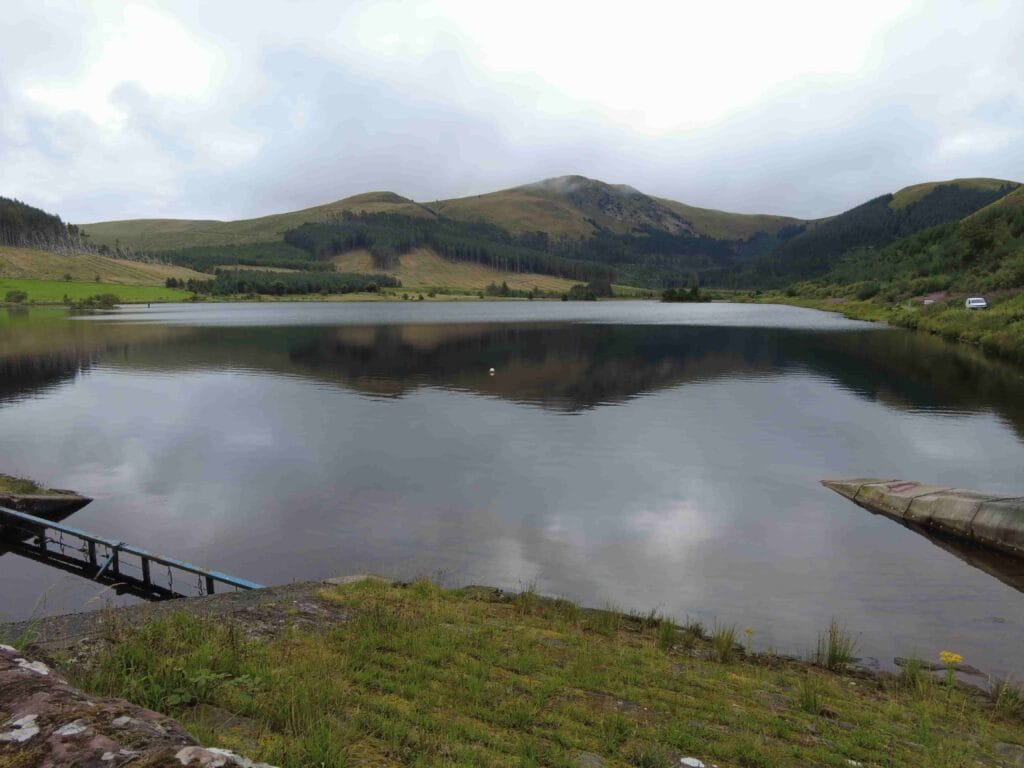
As we finished our walk at Cogra Moss, the clouds creating dramatic shadows across the still water, Rowan played his singing bowl one last time. The sound rippled across the landscape, a reminder that healing work doesn’t have to be loud or confrontational to be powerful.
Sometimes the most radical thing we can do is tend to our own bodies with kindness, build our resilience, and share that knowledge with others walking the same path.
Resources & Connect
Black Body Heart Mind offers courses in meditation, spiritual development, and somatic anti-racism practices. Rowan designs comprehensive yoga courses that give people the tools to practice independently, teaching them to fish, rather than feeding them.
Links
- https://www.blackbodyheartmindconsultancy.com/
- linkedin.com/in/rowan-carr-5b23403a
- https://www.instagram.com/onerowancarr/
Cogra Moss is a stunning, peaceful and flat walk. It’s peaceful and varied, from the water to the woodland.